How-to
How to use resin casting powder: water ratio, mixing and cure time
Published
As an Amazon Associate we earn from qualifying purchases. This does not change our picks. Affiliate disclosure
New to Prime? Try Prime free for fast, free shipping on eligible items.
Short answer
Weigh the powder and the water on a scale. Let's Resin gives 3 parts powder to 1 part water by weight. Stir about 2 minutes, pour at once, demold in 25 to 30 minutes and allow about 2 hours for a full cure. Ratios differ by brand, so the bag in your hand decides.
Gear for this job
All 6 picks comparedLET'S RESIN resin casting powder, 3000 g
See price on AmazonSee it on AmazonVividye eco resin casting powder kit, 4500 g
See price on AmazonSee it on AmazonKISREL resin casting powder, 5000 g
See price on AmazonSee it on Amazon
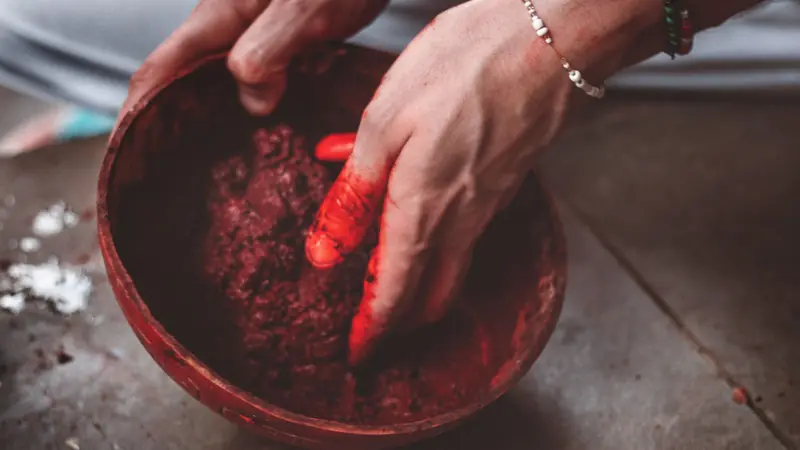
Resin casting powder is a water-mixed, plaster-type powder that people pour into the same silicone molds they use for epoxy. It needs no hardener and no UV lamp, and it sets (searchers also say dries) opaque white, never clear. Three things decide the result: a ratio measured by weight, a pour made right after mixing, and a sealer on anything that will meet water. The figures here come from one maker, Let's Resin, and are labelled as such.
What is resin casting powder?
Despite the name, it is not resin. Maker listings describe it as a plaster or gypsum casting powder that hardens when mixed with water, and some sell it as eco resin. It comes as a fine white powder in bags of roughly 1 to 5 kg and is aimed at trays, coasters, candle holders, figurines and planter pots cast in silicone molds.
What it cannot do matters as much. It cures to an opaque white, so it will not give the clear, glassy look of epoxy or UV resin, and anything embedded in it will not show through. Let's Resin states that its powder is porous and not water-resistant after curing until it is sealed. For clear castings, see UV resin vs epoxy resin.
Resin casting powder ratio: how much water?
Let's Resin gives 3:1 powder to water by weight, not by volume, and says the consistency can be adjusted with a little more or less water. Other brands print 10:3 by weight, which is slightly less water for the same powder. The numbers are close but not the same, so use the ratio on your own bag and weigh both parts on a kitchen or gram scale. The casting powder guide lists the ratio each brand prints.
| Powder | Water at 3:1 | Water at 10:3 | Total mix at 3:1 |
|---|---|---|---|
| 150 g | 50 g | 45 g | 200 g |
| 300 g | 100 g | 90 g | 400 g |
| 600 g | 200 g | 180 g | 800 g |
| 900 g | 300 g | 270 g | 1,200 g |
| 1,500 g | 500 g | 450 g | 2,000 g |
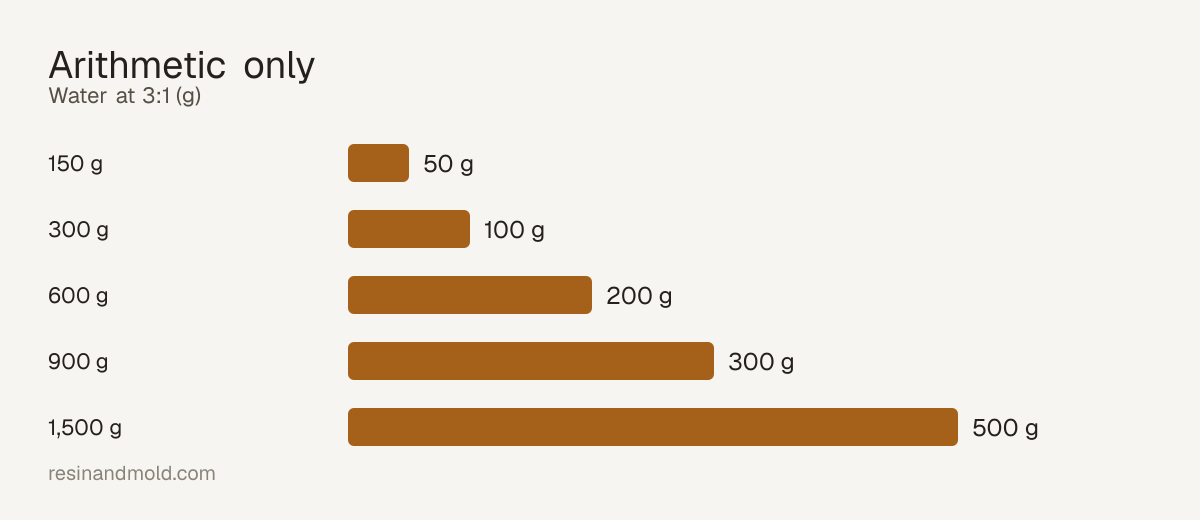
Note.The makers checked do not publish how many grams fill a given mold volume. Mix a small batch first, note how far it went, and scale up from there.
How to mix and pour resin casting powder
Set out the mold, scale, cup and any colorant before adding water, because the mix has to be poured as soon as it is stirred. The same silicone molds work for epoxy and for powder as long as they are clean and dry: see how to clean silicone resin molds. The amounts below are for a 400 g batch at Let's Resin's 3:1 ratio. Change the water amount if your bag prints a different ratio.
- 1
Place a clean, dry silicone mold on a level, covered surface close to where you mix, so the pour takes seconds.
- 2
Weigh 300 g of powder and 100 g of clean water on a scale, which is 3:1 by weight. Do not measure with cups: the ratio is not by volume.
- 3
Combine powder and water in a mixing cup. For color in the body, add colorant now in small amounts. Let's Resin suggests water-based acrylic paint for vivid color and mica powder for pastel shades.
- 4
Stir for about 2 minutes, scraping the sides and bottom, until the mix is smooth with no dry lumps. Let's Resin describes the right consistency as thin and water-like.
- 5
Pour into the mold right away. The maker says to pour immediately after the 2 minute stir, so do not let the cup sit.
- 6
Tap the filled mold on the table several times. Let's Resin says leftover bubbles can be popped by tapping the silicone mold.
- 7
Leave the mold flat and undisturbed for 25 to 30 minutes, the demold time Let's Resin gives. Some other brands list 20 to 30 minutes.
- 8
Peel the silicone away from the piece and push it out from the back. Let it stand in open air for about 2 hours for a full cure before sanding, painting or sealing.
How do you know it is ready to demold and fully cured?
Go by the clock on your bag first. Let's Resin lists 25 to 30 minutes to demold and about 2 hours to a full cure. Some listings give a full cure range of 2 to 6 hours. At demold time the piece should feel firm across the whole surface and come away from the silicone cleanly. If an edge crumbles or stays behind in the mold, the rest needs longer.
Thin walls and fine details are the weak point. Let's Resin warns that tiny details may break off if a piece is demolded before it has fully cured, so for delicate molds wait closer to the full cure time. Makers publish no figures for cure time by room temperature or thickness, so a cold room or a thick piece simply means more waiting.
Is resin casting powder waterproof?
No, not on its own. Let's Resin states that the cured material is porous and not water-resistant, and that it can be sealed with varnish, acrylic sealer or wax sealer. An unsealed coaster or tray will take up water from a wet glass. Seal every face, including the base, after the full cure and after any paint has dried, and follow the drying time on the sealer.
A sealer makes the surface resist water. It does not make the piece a food-contact item. The maker page checked says nothing about food contact, so treat finished pieces as decor: trinket trays, candle holders, ornaments. Some kits include a gloss varnish for this step, and others leave it as a separate purchase.
Can you paint resin casting powder?
Yes, in two ways. Color can go into the wet mix: Let's Resin lists pigments, mica, glitter, quartz, sand and gold leaf as add-ins during mixing, added a little at a time. Or paint the surface afterward. The maker says the piece can be sanded and painted with acrylic paint once it is completely cured, which means after about 2 hours, not at demold time. Seal over the paint. For shimmer colors, see the mica powder guide.
Resin casting powder vs plaster of paris and epoxy
Casting powder and plaster of paris are the same kind of material: a gypsum plaster that sets with water. Listings call casting powder a plaster or gypsum casting powder, and one Let's Resin kit listing calls it a plaster of paris powder outright. The makers checked publish no hardness or strength figures, so a claim that it is stronger than hardware-store plaster cannot be confirmed here. What the listings do give is a weight ratio, a demold time and a fine powder sold for detailed silicone molds.
Against epoxy the trade is speed for clarity. Powder is out of the mold in under an hour and needs only water, but it stays opaque and has to be sealed. Epoxy takes a day or more and careful measuring of two parts, and it is the one that cures clear.
| Point | Resin casting powder | Casting epoxy |
|---|---|---|
| Mixed with | Water, 3:1 by weight | Hardener, by volume or weight per the label |
| Demold | 25 to 30 minutes | 18 to 24 hours |
| Full cure | About 2 hours | 72 hours |
| Look | Opaque white | Clear, can be tinted |
| Water | Porous until sealed | Cured epoxy resists moisture |
| To cure | No hardener, no lamp | Steady room of about 70 to 80 F |
Quick answers
Short answers on resin casting powder. Times and ratios are Let's Resin's published figures, and other brands differ, so read the bag you bought.
- What is resin casting powder? A water-mixed plaster or gypsum powder that sets opaque white in a silicone mold. It is not resin and needs no hardener or lamp.
- What is the resin casting powder ratio? Let's Resin gives 3:1 powder to water by weight. Some brands, including several sold as eco resin casting powder, print 10:3 by weight.
- Is resin casting powder waterproof? No. Let's Resin says it is porous and not water-resistant until sealed with varnish, acrylic sealer or wax sealer.
- Can you paint resin casting powder? Yes. Mix color into the wet batch, or sand and paint with acrylic paint after the full cure of about 2 hours.
- Resin casting powder vs plaster of paris? Same family of gypsum plaster. Makers publish no strength figures, so follow each bag's own ratio and times.
What you need for this
- See price on AmazonAmazon
LET'S RESIN resin casting powder, 3000 g
From Best resin casting powder: water ratio, finish and bag sizes
- See price on AmazonAmazon
LET'S RESIN mica powder set, 60 colors x 5 g
From Best mica powder and pigment powder sets for epoxy and UV resin